
Cutting Corners Construction Cost: Why Shortcuts Undermine Value
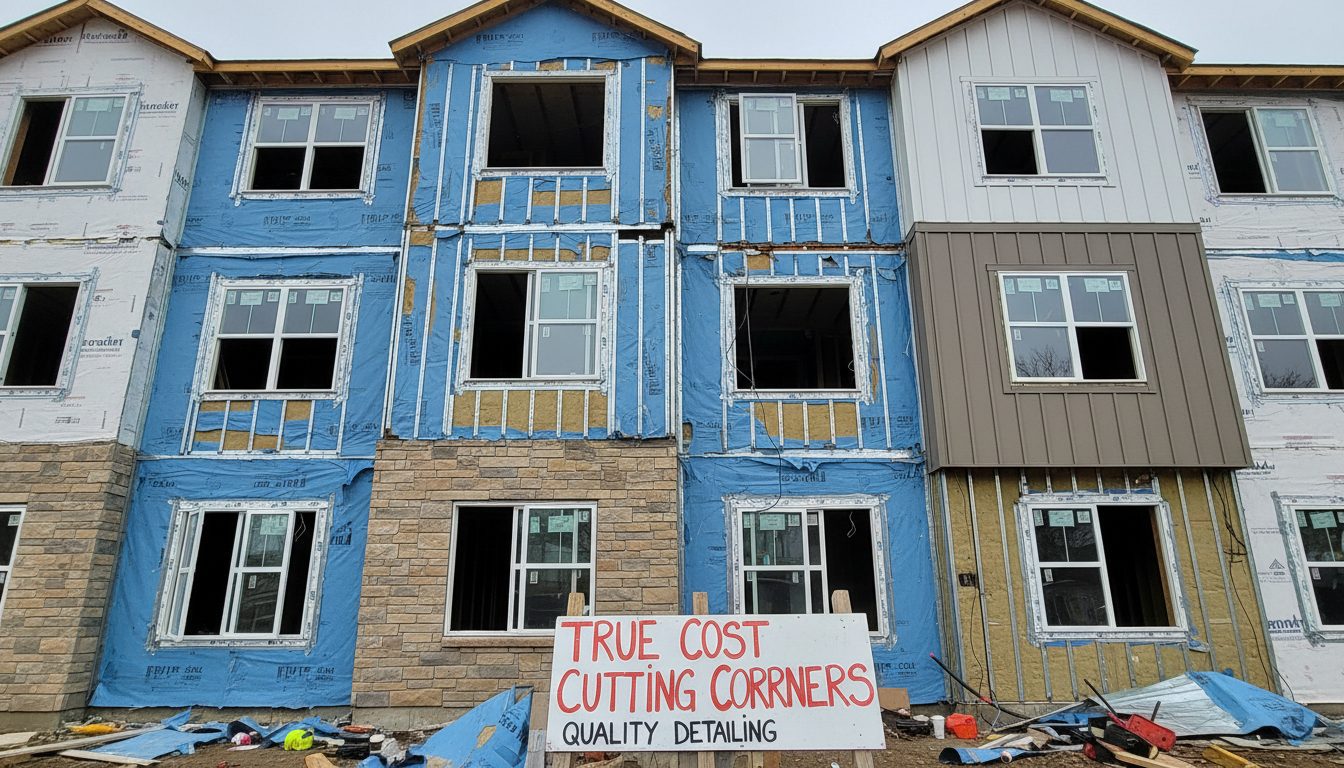
True Cost of Cutting Corners in Construction
In residential construction, cost pressure is unavoidable. Budgets are finite, schedules are compressed, and material pricing remains volatile. As a result, the true cost of cutting corners in construction is often underestimated. While pressure is constant, the decision to cut corners is not inevitable, and more importantly, it is rarely without consequence.
For architects, engineers, and discerning homeowners, construction quality is not an abstract ideal. It is the mechanism through which design intent, performance, and long-term value are either preserved or quietly eroded. When shortcuts are taken in the field, the effects tend to surface later, often when accountability has become diffuse, and remediation is costly.
Where Cutting Corners Actually Begins
Contrary to common belief, cutting corners rarely appears as a single overt decision. Instead, it unfolds incrementally. A material substitution here, a sequencing change there, or a detailing simplification introduced to “keep things moving.” Each adjustment may appear reasonable in isolation. However, over time, these decisions accumulate and fundamentally alter how a building performs.
For example, sequencing adjustments can compromise moisture control. Substituted materials may meet minimum requirements yet fail to deliver durability over time. Detailing changes made for convenience often affects transitions between assemblies, where failures most frequently occur.
As a result, what began as a cost-saving measure becomes a long-term liability.
The Cutting Corners Construction Cost Revealed Over Time
The irony of cutting corners is that initial savings are often illusory. While upfront costs may be reduced, long-term expenses tend to increase. Maintenance cycles shorten. Energy performance declines. Premature repairs become necessary. In some cases, corrective work requires partial demolition, disrupting occupancy and incurring significant expense.
Moreover, these costs are rarely isolated to physical repairs. Disputes between project stakeholders become more likely. Warranty claims are increasing. Trust between the client, architect, and builder is strained.
Understanding the true cost of cutting corners in construction requires looking beyond the moment of decision and evaluating outcomes over the building’s lifespan.
Protecting Architectural Intent Through Disciplined Execution
Architectural intent is most vulnerable during construction. Drawings may be clear, but execution determines whether those ideas translate into a durable reality.
Quality construction supports architecture by ensuring assemblies are installed as designed, transitions are respected, and tolerances are maintained. This requires coordination, not improvisation. When trades are aligned and sequencing is deliberate, details remain intact and performance follows.
At Sordan Construction, quality is approached as a system rather than an aesthetic preference. Trades are coordinated to protect detailing. Decisions are documented clearly. Execution is reviewed continuously to ensure alignment with design intent.
This disciplined approach reduces rework, minimizes disputes, and allows architectural decisions to age well.
Why Massachusetts Amplifies the Risk of Shortcuts
In Massachusetts, the consequences of cutting corners are amplified. Building codes are rigorous, permitting processes vary by municipality, and inspections are thorough. Assemblies that are improperly executed often fail inspection, triggering delays and corrective work.
Additionally, the regional climate places increased stress on buildings. Moisture management, insulation continuity, and detailing are critical to long-term durability. When shortcuts are taken, failures tend to emerge sooner and with greater impact.
For this reason, disciplined execution is not optional in Massachusetts. It is foundational.
Quality as Risk Mitigation, Not Excess
Quality construction is often misunderstood as an upgrade. In reality, it is risk management.
When decisions are made thoughtfully, sequencing is respected, and documentation is maintained, risk exposure decreases. Callbacks are reduced. Disputes become less frequent. Long-term performance improves.
Moreover, quality construction supports collaboration. Architects retain confidence that their designs will be executed faithfully. Homeowners gain clarity and predictability. Builders operate within a framework that prioritizes accountability.
Early Collaboration Changes Outcomes
Many of the risks associated with cutting corners originate before construction begins. When pre-construction is rushed or undervalued, assumptions go unchallenged and details remain unresolved.
Early collaboration between architect, builder, and client allows constructability issues to be addressed proactively. Budget alignment becomes clearer. Sequencing strategies are developed before constraints emerge in the field.
As a result, pressure during construction decreases, and the temptation to cut corners diminishes.
Long-Term Value Is Built, Not Assumed
Ultimately, buildings reveal the quality of their construction over time. Those built with discipline tend to perform quietly and predictably. Those built with shortcuts demand attention, maintenance, and correction.
The true cost of cutting corners in construction is not only financial. It affects trust, performance, and the longevity of design intent.
Quality construction does not eliminate complexity. However, it manages it with foresight, clarity, and accountability. In doing so, it protects value long after construction is complete.
